

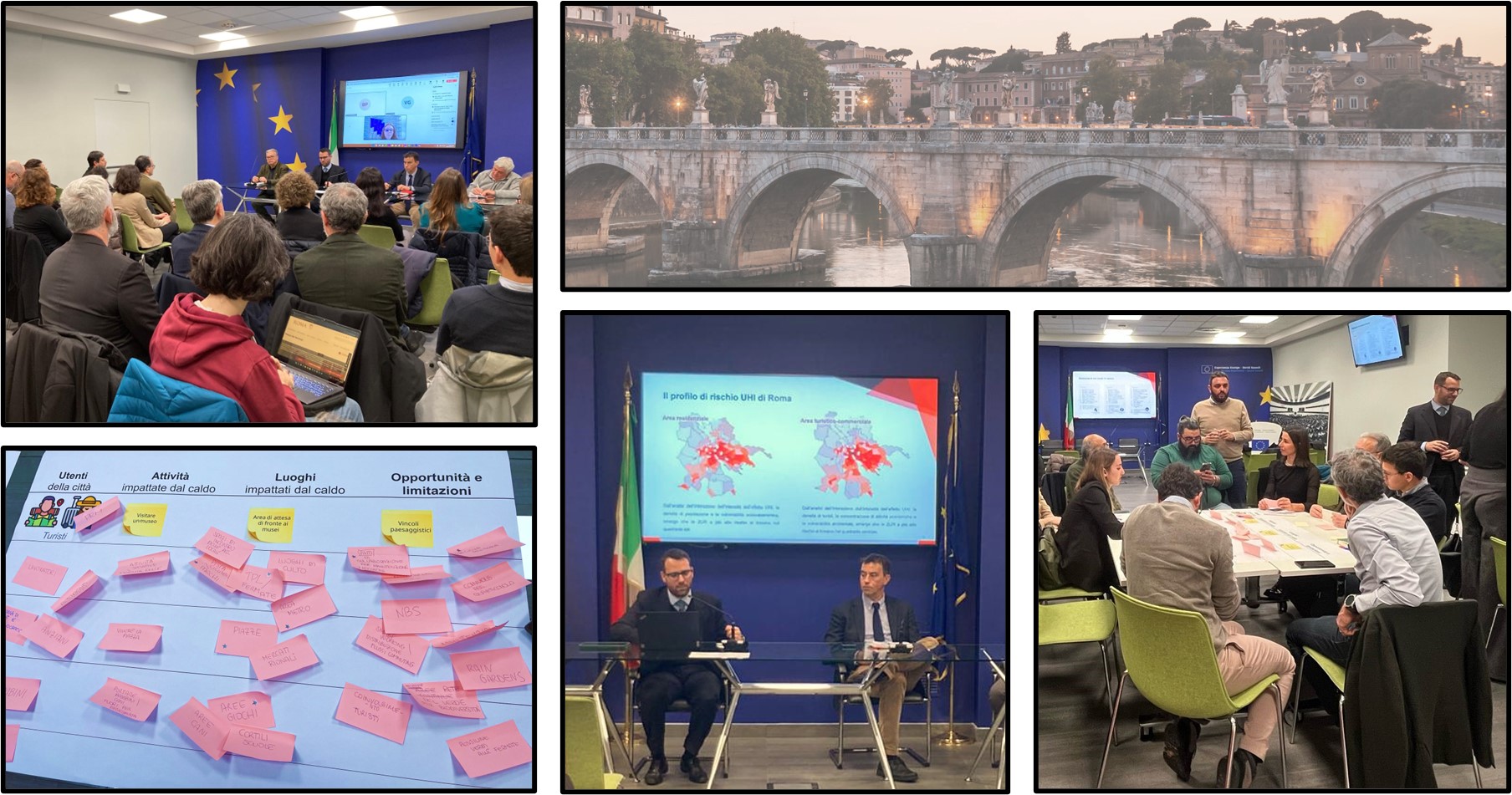
With funding from the European Commission through the Technical Support Facility (TSI), the City of Rome has launched the “Climate Adaptation – The Urban Heat Island Effect in the City of Rome” initiative. The project, led by PwC in collaboration with RomaTre University, ENEA and Ecologic Institute, aims to build a UHI risk profile of the city, analyzing its impacts on health, economy and society, and identifying targeted solutions in two pilot areas of high vulnerability. Also supporting the project is an Advisory Board composed of representatives from the Ministry of Environment and Energy Security, DEP Lazio, CMCC, ISPRA and Cassa Depositi e Prestiti, tasked with providing strategic guidance and scientific validation.
The main activities of the project include:
- The establishment of an integrated UHI risk analysis;
- The development of an urban profile to select two high climate impact zones;
- The co-design of specific mitigation measures;
- The drafting of two action plans, with operational recommendations;
- A training program to strengthen local government capacity in implementing UHI solutions.
A key element of the initiative is the active involvement of local stakeholders-citizens, businesses, institutions-through participatory workshops and capacity building activities to ensure the effectiveness and sustainability of the proposed solutions.
What Rome does through the project
To date, the project has completed its risk analysis, taking into account factors such as the intensity of the urban heat island effect (UHI), housing density, socioeconomic vulnerability, tourist flows and the presence of economic activities. This approach made it possible to identify two areas representative of different urban settings:
- Centocelle/Alessandrino-high-density residential neighborhoods where nighttime thermal impact strongly affects the health of the population;
- Old Town – a predominantly tourist and commercial area, where high temperatures affect the local economy and visitor flows, as well as the health of residents.
With this project, Rome reaffirms its leadership in building a more resilient, sustainable city that is ready to deal with future climate impacts.


