

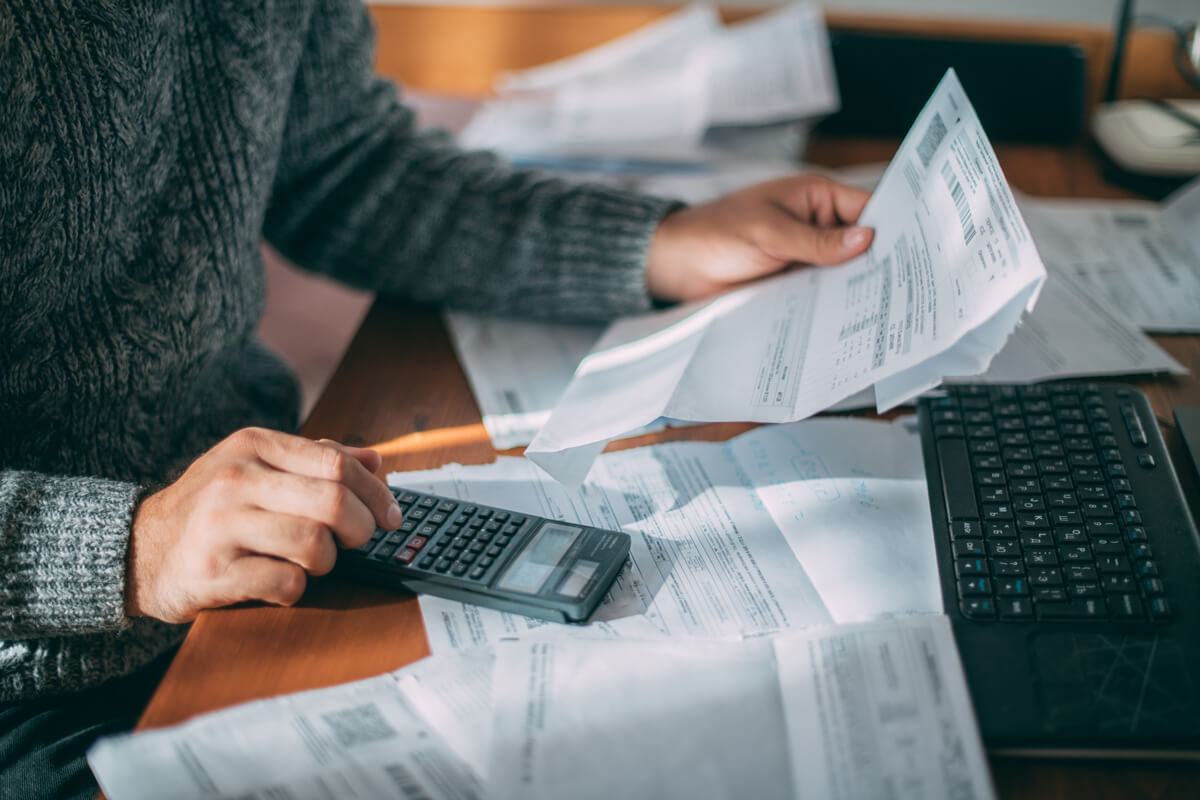
The bill as we know is the official document that certifies our gas and electricity withdrawals from the distribution network.
Let’s see what information is useful to understand our consumption and related costs that we can read from gas and electricity bills.
Videoriassunto - Come leggere la bolletta
Reading the electricity bill
The electricity travels to our homes via electric cables to the delivery point (“Point Of Delivery” – POD) to which is associated a unique code that identifies our. The POD is connected to a meter that measures the electricity consumption of our home. Electricity is measured in kWh (kilowatt hours).
Generally speaking, the costs associated with electricity consumption are divided into three different categories:
- Costs relating to energy consumption in kWh (kilowatt-hours) (the more energy you use, the more you pay). The amounts are expressed in €/kWh.
- Costs relating to the power in kW (kilowatts) available at the meter (the more kW of power I use, the more € I pay per kW). The amounts are expressed in €/kW.
- Fixed monthly charges that are independent of both consumption and power. The amounts are shown in €/month.
Part of these amounts is set by the electricity suppliers – and therefore varies depending on the offers from the various suppliers – whilst another part is the same for all suppliers, as it is set by the relevant authorities (these are known as ‘pass-through costs’).
Looking at the bill in more detail, the amounts are broken down as follows:
Amounts that depend on the seller
These are the amounts that can be compared across the various offers and which may vary from seller to seller.
They are shown on the bill both in the ‘Energy Statement’ section, labelled ‘of which: cost of energy supplied’, and in the ‘Tariff’ section, labelled ‘total amount due for the tariff’.
Furthermore, these amounts are set out in the sales contracts under the heading ‘Sale of electricity’.
Amounts that do NOT depend on the seller (TRANSITORY PAYMENTS)
These are the amounts we do not pay to the seller but that are used to cover the costs of operating the grid, the general expenses of the electric power system, taxes, and VAT.
They are listed on the bill, both on the Energy Statementand in the Offer section, as well as in the detailed breakdown and in the sales contracts under the headings “electricity grid usage fee, ” “general system charges, ” “taxes, ” and “VAT rate.”
What Do Certain Specific Items on Your Energy Bill Mean?
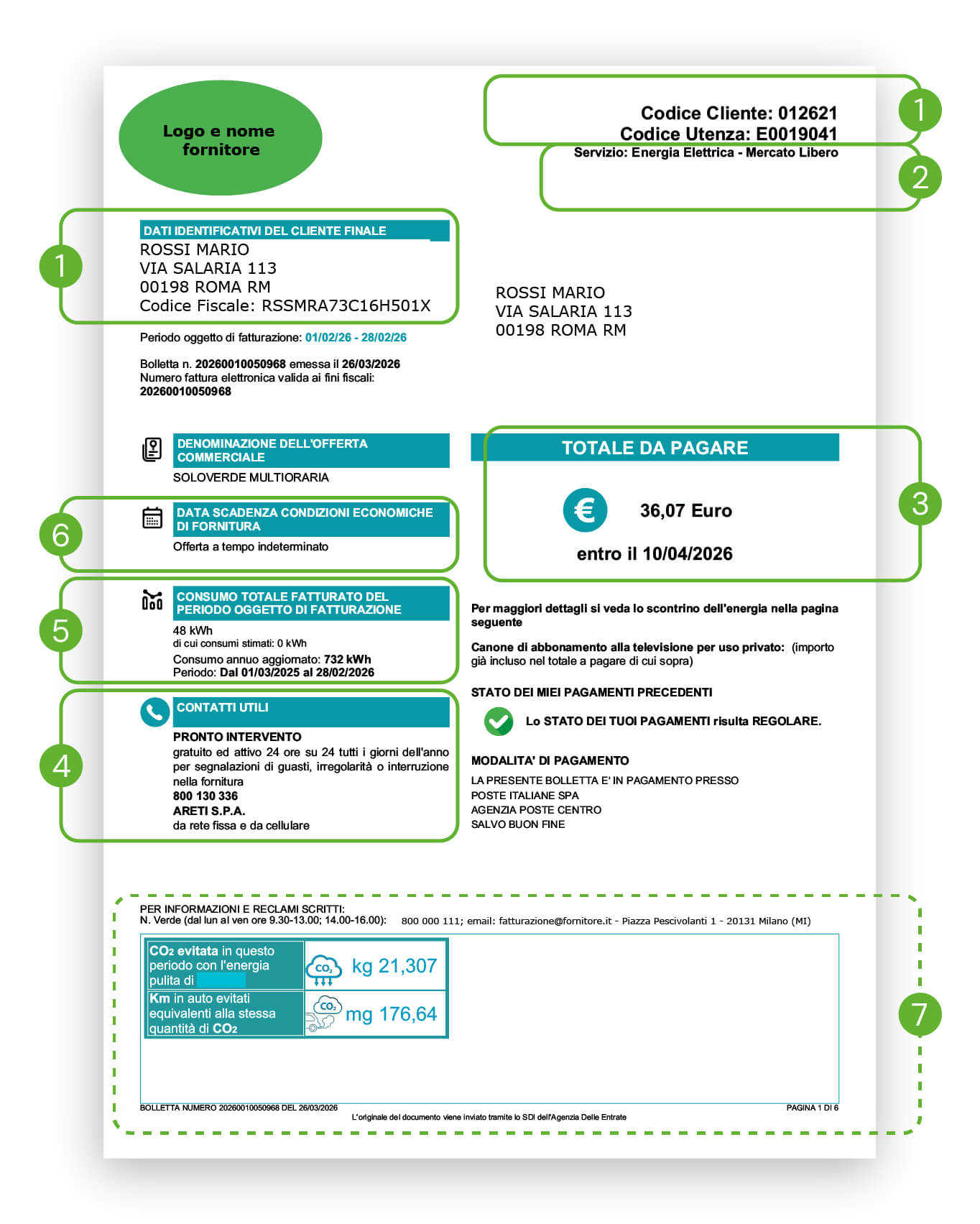
Title Page
End Customer Identification Information
Identifying information for the holder of the supply contract (last name and first name, residential address, tax ID number). The supplier also assigns a customer code and a specific utility account code.
Market Type
The market can be either free or regulated (protective regime), but only for specific categories of users. Protection can also be “phased”—that is, provisional until March 2027 (after which users automatically transition to the free market).
Total Amount Due
Total amount and payment due date.
Useful Contacts
24/7 Contact for Outages and Service Interruptions (The company responsible for the cables and meters will answer your call.)
Total sales for the billing period
The amount of electricity consumed covered by the bill.
Expiration Date of the Terms and Conditions of Supply
Validity Period of the Offer’s Financial Terms.
Announcements
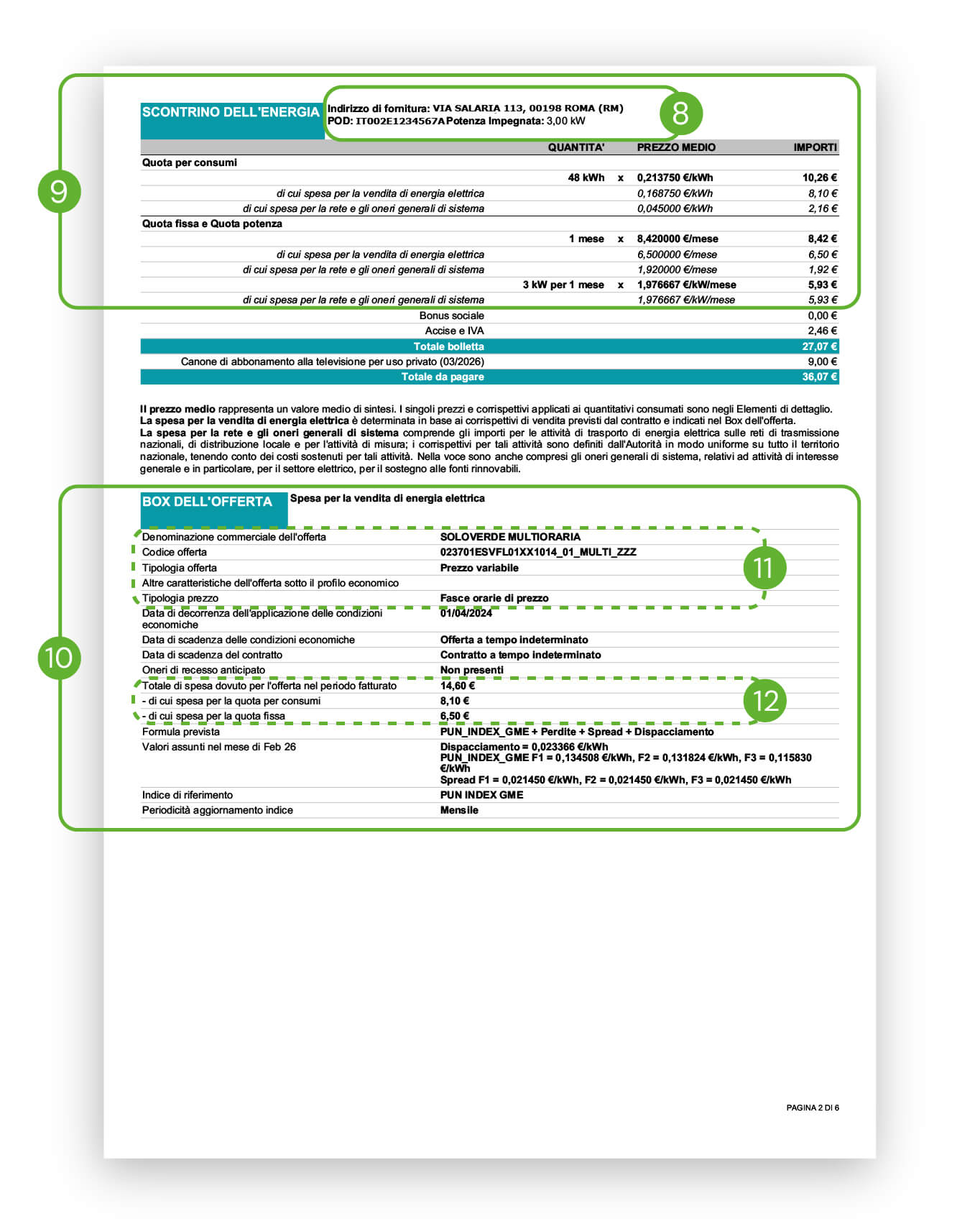
Energy Bill
Delivery Details
The supply address, the POD code that identifies the meter, and the point of supply are listed (Point of Delivery), and the meter’s power rating (kW).
Allocation of Quotas
The breakdown of invoiced amounts by type is described as follows:
- amounts due for consumption
- Fixed amounts independent of consumption and based on meter capacity
Offer Box
Offer Box
This section outlines the seller’s terms and conditions.
General Information About the Offer
The name, unique code, and type of offer are listed.
Financial Details of the Offer
The following is shown: the total amount charged on the bill, which depends on the plan.
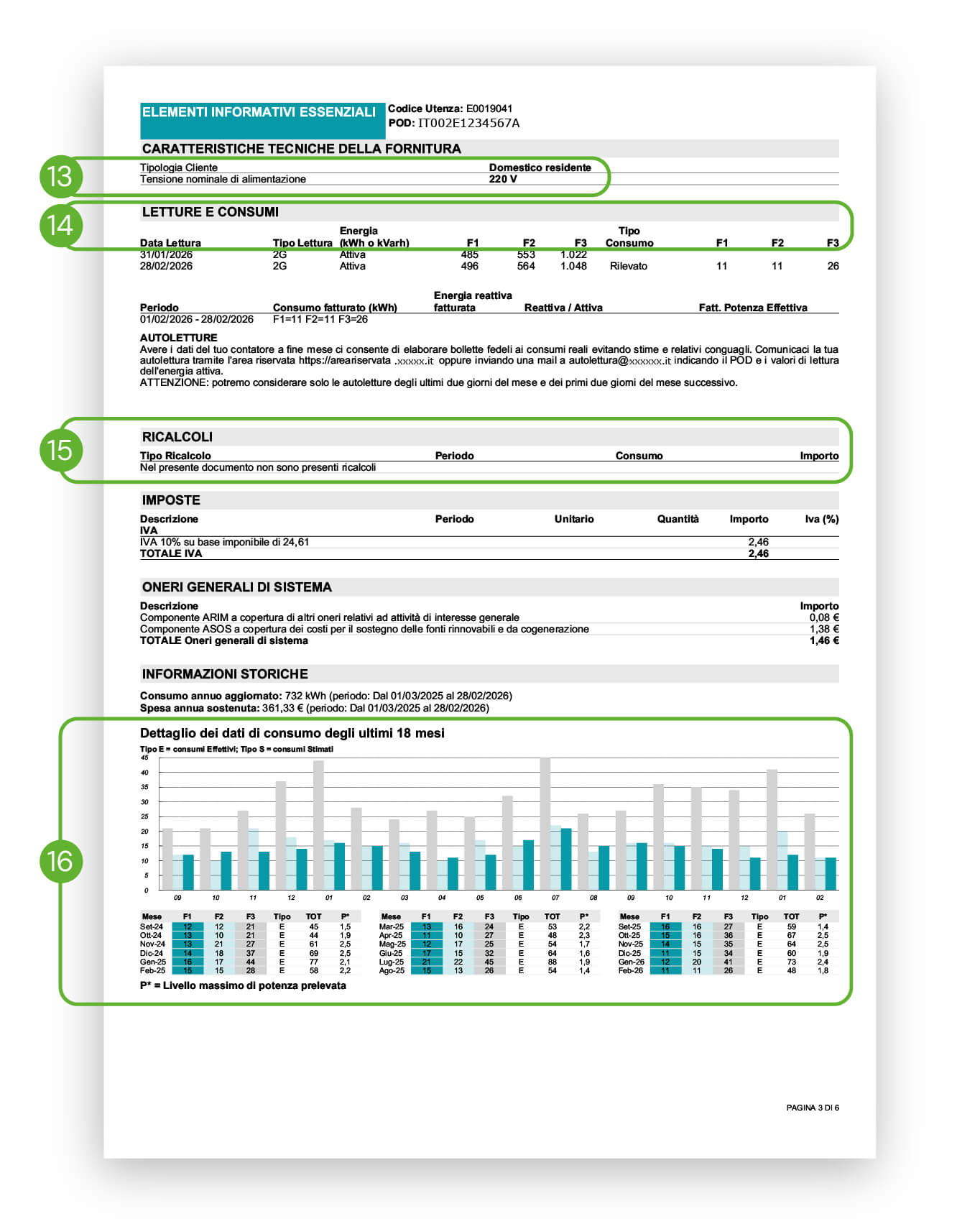
Essential Information
Technical Specifications of the Supply
The customer type is listed, which can be resident household, non-resident household or other non-residential uses (such as garages, offices, businesses, stores, etc.).
Meter Readings and Usage
This section lists all the data recorded by the meter that have been read by the distributor (meter readings) or reported by the customer (self-readings) or estimated data (estimated readings).
Energy consumption figures are also shown, calculated as the difference between two consecutive meter readings. Billed consumption may include both actual and estimated consumption.
Recalculations
The “Recalculations” section appears only if the bill includes recalculations of amounts already billed in previous bills. If consumption was overestimated or underestimated in previous bills, the bill indicates the period and the consumption figures that were estimated, along with the corresponding amount.
Details of consumption data for the last 18 months
Historical trends in consumption and power draw. Consumption is broken down by time period:
- F1, Mon–Fri (8 a.m.–7 p.m.)
- F2, MON–FRI (7–8 a.m., 7–11 p.m.) and SAT (7 a.m.–11 p.m.)
- F3, (23 hours a day, 7 days a week + 24 hours on holidays)
It allows customers to monitor and evaluate their usage.
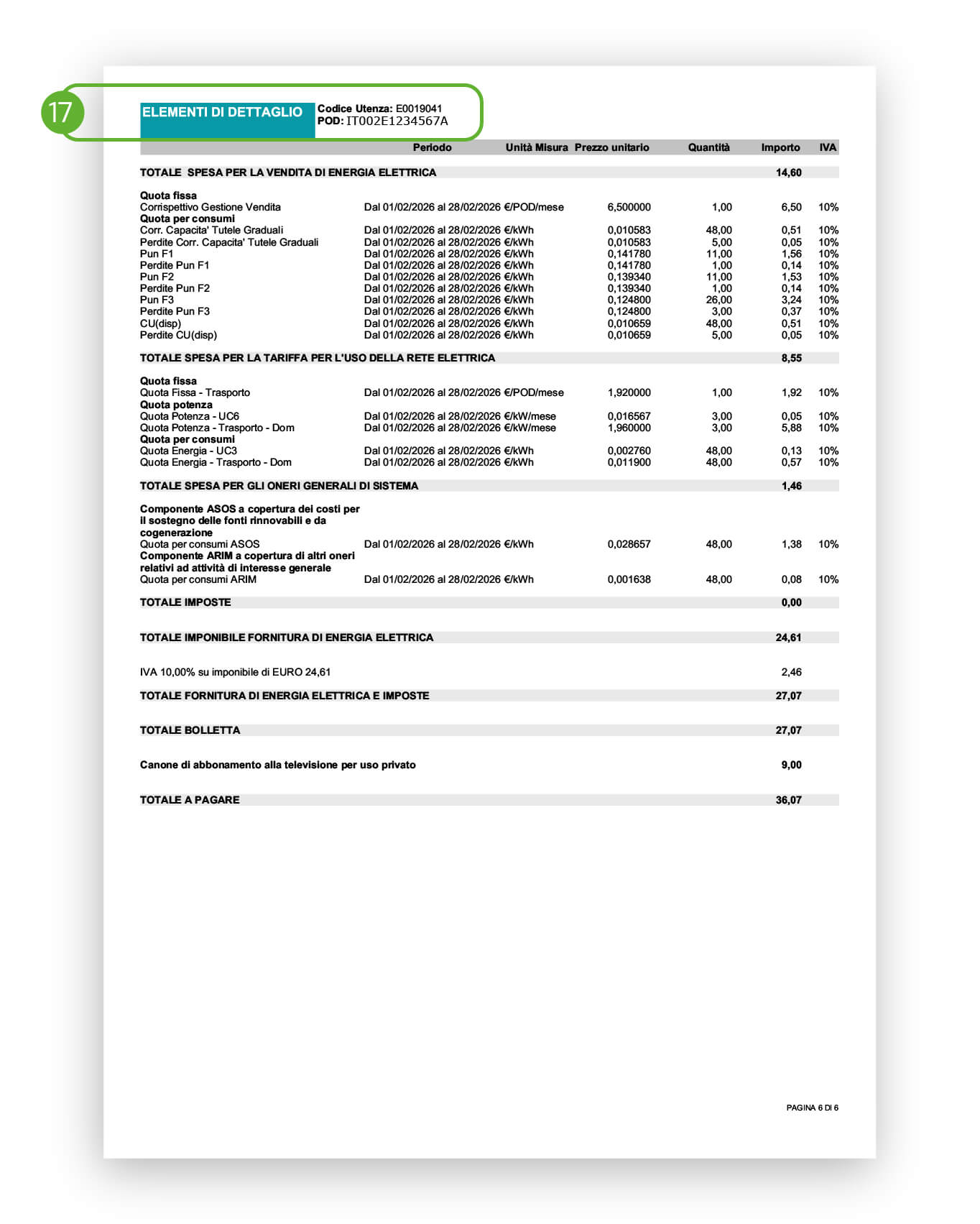
Detailed Elements
Detail Element Data
The itemized breakdown lists all charges billed on the statement, broken down by section.
They can be requested from the supplier or downloaded from the supplier’s website in the members-only area.
Some suppliers send customers a bill that includes a detailed breakdown, while others send a bill without this section.
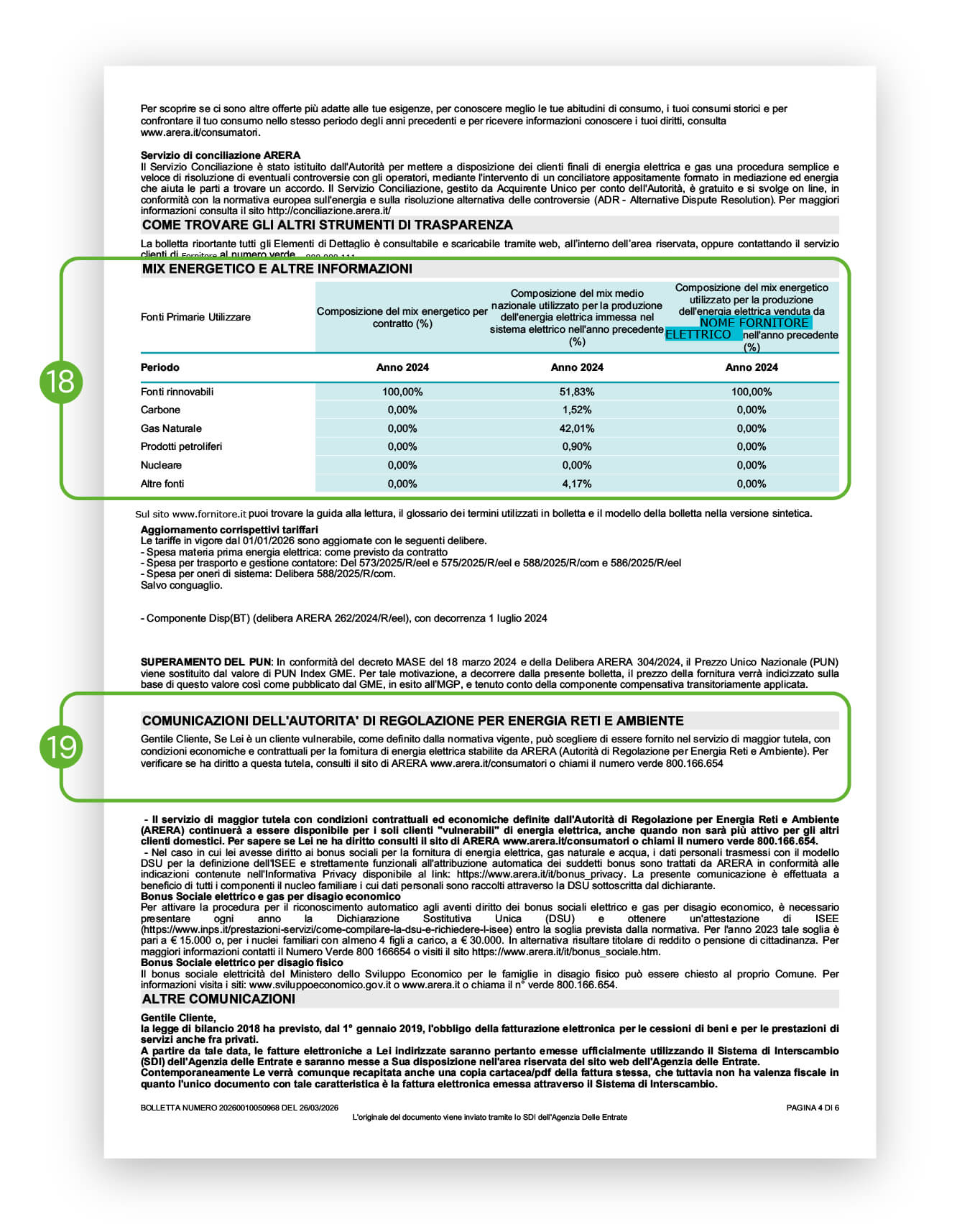
Energy Mix
Energy Mix and Other Information
The box shows the types of energy sources the supplier uses to fulfill the customer’s contract and to supply all of its customers in general, indicating the percentage of each type relative to the total.
The table also shows the percentage breakdown of the overall energy supply mix at the national level.
Announcements from the Energy Authority
Communications from the Regulatory Authority for Energy, Networks, and the Environment
Each bill includes a specific section dedicated to any communications from ARERA (Regulatory Authority for Energy, Networks, and the Environment).
Are there any terms on your bill that you'd like to know more about, or that we haven't covered?
How to Read Your Gas Bill
Natural gas reaches our homes through pipelines that connect to a delivery point (PDR) with a unique code associated with our account. Attached to the PDR is a meter that measures the standard cubic meters (Smc) of natural gas we draw from the network to meet our heating needs.
The structure of the gas bill includes the same information and cost breakdown as the electricity bill. The measured values are shown in cubic meters (Smc) rather than in kWh; however, for gas as well, the cost of supply consists of costs determined by the supplier (expenses for the sale of energy) and passed-through charges (network costs and general system charges, taxes, VAT).